
Views: 0 Author: Site Editor Publish Time: 2025-09-15 Origin: Site


Corrosion is a major concern for industries that rely on metal components. Rust and other forms of metal degradation can compromise structural integrity, reduce operational efficiency, and result in costly maintenance or replacement. Preventing corrosion is not only essential for ensuring the longevity of machinery and equipment but also for reducing operational downtime and financial losses.
Among the most effective corrosion prevention solutions are Volatile Corrosion Inhibitors (VCIs). VCIs work by releasing protective vapors that form a molecular barrier on metal surfaces, preventing contact with moisture, oxygen, and other corrosive agents. Two of the most commonly used VCI products are VCI powders and VCI films. While both are designed to achieve the same goal—protecting metal from corrosion—they have different properties, applications, and advantages. Understanding the differences between VCI powders and films is crucial for selecting the most suitable solution for your industrial needs.
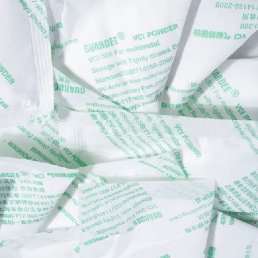
VCI powders are solid corrosion inhibitors that emit protective vapors into the surrounding environment. When placed in enclosed spaces such as storage containers, packaging, or crates, the powder vaporizes slowly, releasing molecules that adsorb onto metal surfaces. This creates a thin, invisible protective layer that shields metals from moisture, oxygen, and other corrosive agents.
VCI powders are particularly suitable for irregularly shaped components or machinery with internal cavities, threaded sections, and recesses. The vapor can penetrate areas that are difficult to coat manually, providing comprehensive protection without leaving residues. VCI powders are typically formulated using organic salts or compounds that are safe to handle, making them ideal for long-term storage and shipping.
VCI films, on the other hand, are plastic films or sheets impregnated with volatile corrosion inhibitors. These films release protective vapors into the enclosed space in a manner similar to powders, forming a protective molecular layer on metal surfaces. VCI films are widely used for packaging, wrapping, and covering metal components during storage or transit.
The films themselves also provide a physical barrier, helping to prevent direct contact with dust, dirt, or other contaminants. They are available in various forms, including standard sheets, bags, tubing, and shrink films, making them highly versatile for different industrial applications. VCI films are especially effective for large metal parts, bulk shipments, or flat components, where a uniform protective layer can be maintained throughout the packaging.
Although VCI powders and VCI films share the same goal of corrosion protection, they differ in several important ways:
VCI powders are applied as loose solid particles inside containers, crates, or packaging. They can be sprinkled directly over components or placed in sachets that release vapors over time. VCI films are pre-formed sheets or bags that wrap or enclose the components, releasing protective vapors while also providing a physical barrier.
VCI powders excel at protecting components with complex geometries, internal cavities, and threaded sections, where vapors can reach areas that films might not cover effectively. VCI films, in contrast, are better suited for flat or uniform surfaces, bulk shipments, or components that can be fully enclosed within the film.
VCI films provide an additional layer of physical protection against dust, dirt, and minor impacts. Powders do not offer such mechanical protection; they rely solely on the vapor-phase corrosion inhibition.
VCI films are easy to handle, wrap, or seal, requiring minimal setup, especially for standard-shaped components. VCI powders may require more careful handling to ensure even distribution and to avoid spillage or dust inhalation. Sachets or containers can simplify powder application, but they still require attention to placement and quantity.
VCI powders are generally clean and leave minimal residue, but excessive powder can require light cleaning, especially if the components are sensitive or require further processing. VCI films leave no residue on the metal surfaces themselves, and the film can simply be removed when the components are ready for use.
VCI powders are widely used in industries where components are stored or shipped for extended periods. In the automotive sector, powders protect engine parts, gear systems, and transmission components during transport. In industrial machinery, powders safeguard complex tools, spare parts, and equipment with intricate shapes or hidden cavities.
VCI powders are also ideal for marine and offshore applications, where high humidity, salt, and fluctuating temperatures accelerate corrosion. They can be placed inside crates, containers, or sacks to protect metal components during long storage or transit periods. Additionally, in metal fabrication and precision manufacturing, powders prevent corrosion in parts that require further machining, painting, or assembly, ensuring clean surfaces that are ready for subsequent processes.
VCI films are commonly used for wrapping and packaging metal sheets, pipes, and large components. They are effective in warehouses, distribution centers, and shipping containers, providing both vapor-phase protection and a physical barrier against contaminants.
In the electronics and electrical equipment industries, VCI films are used to cover metal enclosures, switchgear, and delicate metal parts, ensuring that the surfaces remain free from corrosion without leaving residues that could interfere with assembly or performance. VCI films are also useful for automotive body panels and large industrial equipment, where large surfaces need consistent and uniform corrosion protection.
Both VCI powders and films offer significant benefits over traditional corrosion prevention methods, such as oils, coatings, or greases.
VCI powders provide superior coverage for irregular shapes, hidden surfaces, and components with internal cavities. They are lightweight, easy to store, and ideal for long-term protection in containers or crates.
VCI films offer uniform protection for flat or regular-shaped components, combined with a physical barrier that prevents contamination. They are easy to use, reduce cleaning requirements, and are versatile for different packaging formats, including sheets, bags, and shrink films.
Selecting the right VCI product depends on several factors. For components with complex geometries, powders are usually the best option because the vapors can reach hard-to-access areas. For flat or bulk items, films provide uniform coverage while adding mechanical protection. The choice also depends on storage duration, environmental conditions, and handling requirements.
In some cases, a combination of VCI powders and films may offer the best solution. For example, powder sachets can be placed inside crates wrapped with VCI films, providing both vapor-phase protection and a physical barrier, especially in long-term storage or harsh environmental conditions.
Regardless of the form, proper handling and application are critical for effective corrosion protection. Surfaces should be clean and dry before applying VCI powders or wrapping components with VCI films. For powders, ensure even distribution and appropriate quantities based on container size and the number of components. For films, seal edges and ensure that the entire surface is enclosed to maintain a stable vapor environment.
Regular inspections are recommended for long-term storage, especially in environments with high humidity or temperature fluctuations. Replenishing powders or replacing films as needed ensures continuous protection and prevents corrosion-related losses. Combining VCI products with desiccants or climate-controlled storage can further enhance their effectiveness.
VCI powders and VCI films are both highly effective tools for preventing metal corrosion, each with unique strengths and applications. Powders excel at protecting complex geometries and internal cavities, while films provide uniform coverage and a physical barrier for flat or bulk components. Understanding the differences, applications, and best practices for these products enables industries to select the right solution for their machinery, equipment, and metal parts.
By choosing the appropriate VCI product, businesses can protect metal assets, reduce maintenance costs, and ensure long-term operational efficiency. Companies like VCI EP NEW MATERIALS (SHANGHAI) CO., LTD. specialize in high-quality VCI powders and films, providing industries worldwide with reliable solutions for corrosion prevention, storage, and shipping of metal components.


